
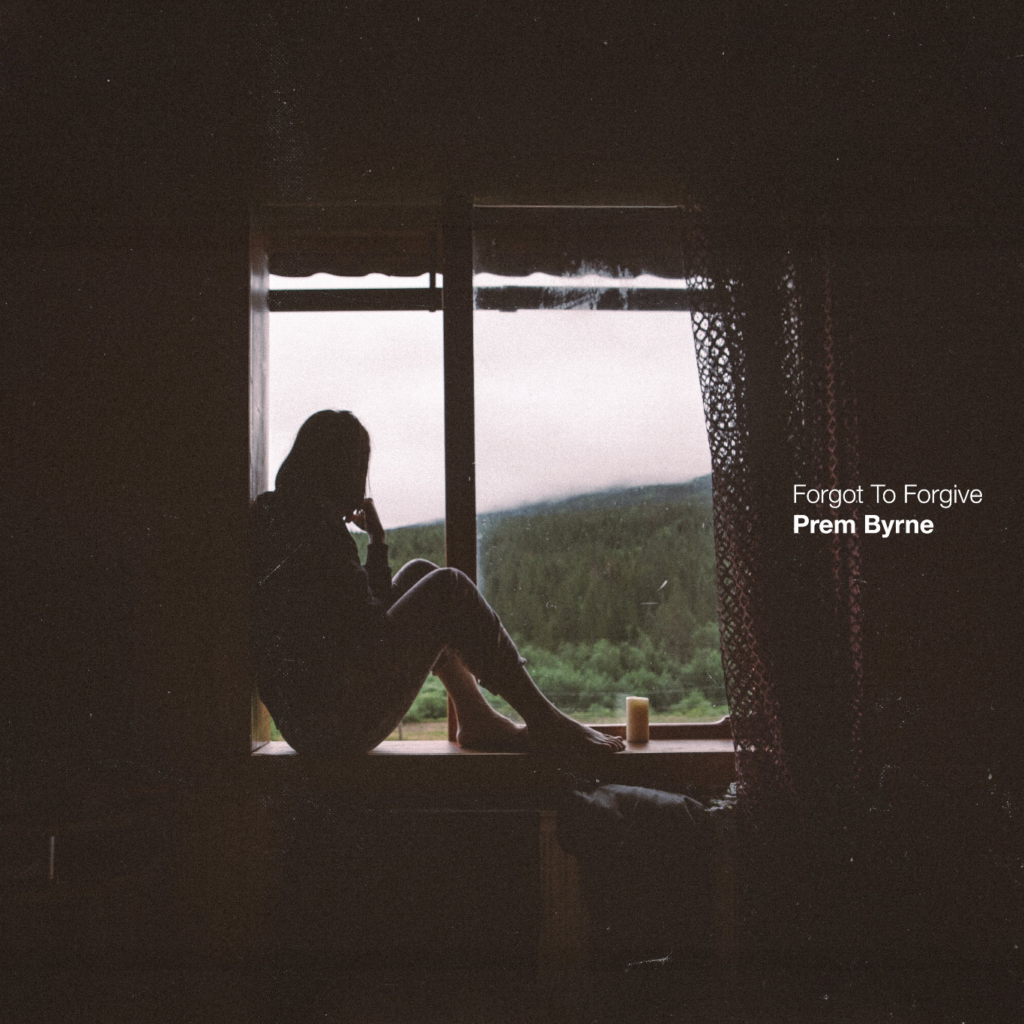
Prem Byrne does not write songs in a rush. His work feels lived in, patient, and quietly intentional, the kind of music that reveals itself over time rather than announcing its meaning all at once. On “Forgot To Forgive,” his most emotionally revealing release to date, Byrne turns inward, tracing the fragile terrain of family, conflict, and reconciliation with a level of honesty that feels both deeply personal and universally resonant.
The song did not begin as a concept or a career move. It began with a phone call. “I had just gotten off the phone with a family member who was confronting me about something I had said to them last Thanksgiving,” Byrne recalls. “I so appreciated the honesty and courage of bringing it up to talk about it rather than letting it fester into resentment and a grudge, something I’ve done in the past, and my family has done as well.”
That conversation lingered. Not because it was explosive or dramatic, but because it cut through a long standing pattern of silence. Byrne describes growing up in an environment where confrontation was rare and unresolved hurt was often left to harden into distance. Over time, he began to notice how those unspoken fractures shaped his family. “I have been noticing that it’s not just the world at large that’s in disarray, but within my own extended family, we are more divided than I ever remember,” he says. “For this reason, I felt extra grateful for the family member who confronted me in an honest way, and for the talk we had.”
When the call ended, Byrne did not try to intellectualize what had just happened. He reached for his guitar.
“After the conversation was over, I picked up my guitar and started working on the song.” What followed was not a tidy act of closure, but the beginning of a longer internal reckoning. “Forgot To Forgive” is not a song that presents forgiveness as a neat solution. Instead, it lives in the discomfort of realizing how easily relationships can fracture when honesty feels too risky to attempt.
Byrne is careful not to present himself as someone who has mastered conflict or reconciliation. If anything, writing the song clarified how far he still has to go. “I wish I could say that I’ve become a master of conflict resolution, but I still experience the same difficulties so many of us feel,” he admits. “It’s difficult to start an honest conversation with people. It’s often too scary, especially with family, because of how explosive things have been in the past.”
Avoidance, he says, can feel like the safer option. Silence can masquerade as peace. “Sometimes it just feels easier and safer to stay silent and wait for things to settle and then continue as if there was no hurt or broken trust,” Byrne says. “I guess this song points to willingness to work on it more, for the sake of saving relationships.”That willingness sits at the emotional core of “Forgot To Forgive.” It is not about absolution or forgetting harm. It is about choosing to stay engaged when disengagement would be easier.
Musically, the song mirrors that emotional complexity. Its structure unfolds in layers, with distinct sections that feel almost conversational in their progression. There is a sense of movement and accumulation, as if each part is responding to the one before it.
Interestingly, that complexity was not planned. “Honestly it was all just kind of a gift, and a lot of it I don’t remember because it just sort of kept happening, and I was absorbed by it,” Byrne says. Some of the song’s most striking moments arrived through unexpected means. The chorus, for instance, came to him in a dream. “I remember that I still needed a chorus and then had a dream where I woke up with this African tribal-like chanting in my head which, when sung through my voice, became the chorus and extended chorus.”
Other sections revealed emotional contrasts within the same melodic framework.
“I’m still incredibly grateful for the pre-chorus, which I used the same melody for in the post chorus,” he explains. “It’s a part of the song that I really love because it kind of gushes out in a passionate way, in the pre chorus as expressing frustration about the situation but then in the post chorus almost as a plea for sanity and respect for the core of the friendship, which was assumed would last into old age.”
Rather than over intellectualizing the arrangement, Byrne trusted the song to tell its own story. “So the complexity was not intentional,” he says. “All these parts just arose and fit together well.” That instinctual approach is consistent with how Byrne understands songwriting more broadly. While he cites foundational influences like Cat Stevens, Tracy Chapman, and Sade, he does not see inspiration as something frozen in time. “With Cat Stevens and Tracy, both artists were usually singing about important things and there’s something in me that is always needing to write something meaningful,” he says.
At the same time, he finds inspiration in contemporary artists whose work feels emotionally precise rather than overtly grand. “When I’m listening to Olivia Dean today, or Sierra Ferrell, or Sabrina Carpenter, I’m usually loving the music, the phrasing, and discovering that the messages are still incredibly meaningful, but just more specific, where the themes are not always so obvious.”
He points to Olivia Dean’s songwriting as an example of how specificity can unlock universality. “In ‘Let Alone the One You Love,’ it seems like a specific situation between her and a boyfriend but suggests a much more universal theme about being made to feel small in a relationship,” Byrne says. “So I’m on the road to find out if I can write that way, specific themes, that have universal appeal.”
For Byrne, the emotional delivery always comes back to instinct. “The way to deliver a message to someone’s heart is always dependent on the music, which for me is just instinctual,” he says. “Sade, Phil Collins, the Bee Gees, Stevie Wonder and all the incredible music I grew up with is still beating in my heart.”
That instinct is sharpened through collaboration, particularly with Adam Rossi of AR Audio, who has become a key creative partner. “Adam is able to see what I’m wanting in a song and take it to the next level,” Byrne says. On “Forgot To Forgive,” Rossi played a crucial role in shaping the balance between vulnerability and restraint, especially in moments where Byrne’s vocals carry emotional weight. “For this song, he kept emphasizing the need to be careful with the drums in the pre and post choruses, because the vocal is occupying so much space,” Byrne explains. “I was sort of feeling like throwing everything at the pre-chorus, sonically, but needed his expertise to guide that part of the song specifically.”
Trust is central to their working relationship. Byrne recalls a moment where Rossi encouraged him to keep a less technically polished flute recording because it captured something irreplaceable. “I wanted to rerecord the Bansuri solo because I had recorded it on a basic mic at home but Adam felt the performance of that recording was better than the others we recorded with better mics and so we went with the original, and he was right.”
That respect for emotional truth over perfection extends to how Byrne thinks about forgiveness itself. He is wary of the idea that forgiving someone means minimizing harm or abandoning boundaries. “Great question, and I’m not sure I am qualified to answer,” he says when asked about the difference between forgiveness and tolerating hurt. He recalls seeing a video that reframed forgiveness not as moral superiority, but as survival. “They shared that they knew they had to forgive, not out of a need to be good, or altruistic, but for their very survival,” Byrne says. “They didn’t want to carry the hatred and poison that can arise when we have been deeply violated.”
Forgiveness, in this framing, is work. It is not passive or effortless. “I imagine that it requires a ton of inner work,” he says. “That might involve writing letters that are never sent and perhaps lighting them on fire in a ritualistic way, praying for help with the process, working with therapists and other modalities.”
Looking back, Byrne sees how his younger self struggled with unresolved hurt. “I spent a lot of my younger years mentally grinding over hurt feelings with friends and family members,” he says. “I learned the long way about the futility of that kind of behaviour.” Age has shifted his perspective on friendship. “I also hope that my younger self could grasp just how special old friendships are,” he says. “Some of my friends now are people that I’ve known for decades and there is a preciousness in these relationships.”
That awareness informs how he performs “Forgot To Forgive” live, often in intimate rooms where the audience feels close enough to register every word. “To look in someone’s eyes and know that a particular line has reached them is a special feeling,” Byrne says. “It’s not something I can experience when I release a song to music streaming platforms.” Still, the song continues to speak to him long after it was finished.
“The final post-chorus, which says, ‘and we can stay friends forever and grow old together,’ has gone deep into my bones now,” he says. “The age I’m at, I don’t take friendship lightly anymore.” He pauses before adding, “I know that a friendship is like a delicate plant. I need to protect it, water it, feed it, and take out the weeds if there are any threatening it.”
In “Forgot To Forgive,” Prem Byrne is not offering answers. He is offering presence, reflection, and a reminder that connection requires effort long after the initial hurt fades. It is a song shaped by time, by listening, and by the quiet courage it takes to stay open when closing off feels easier. And in that honesty, Byrne finds something lasting.
Featured Image: Artist Supplied