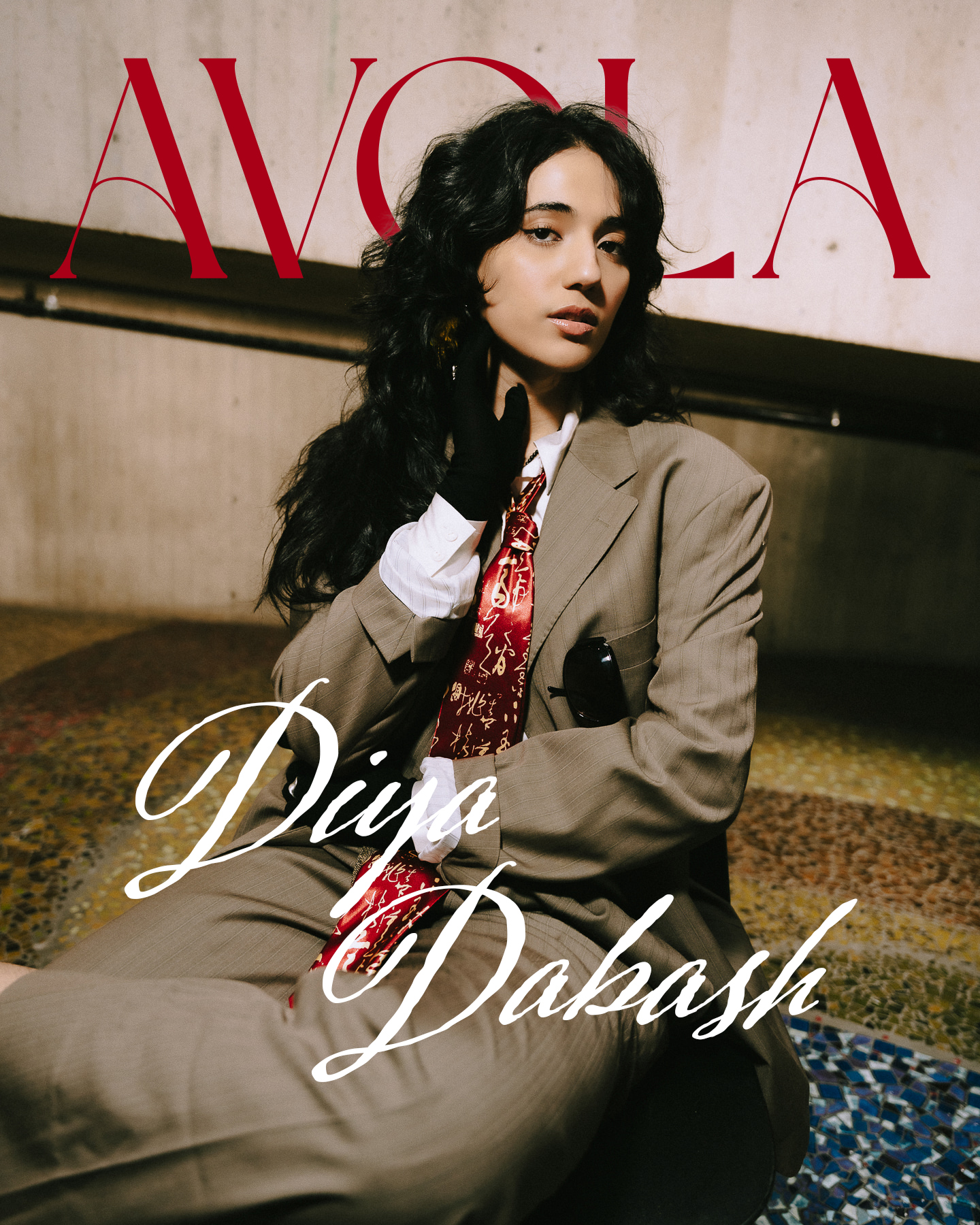
Blake Madison remembers music before she understood it. Not as theory, or training, or ambition—but as a kind of atmosphere that rearranged the room. In her earliest memory of it, she is a child in Washington, DC, lying still while choral music drifts through the Washington National Cathedral, the sound folding itself into something almost physical. “I remember music always making sense to me,” she says. “It was the one thing I never questioned.”
That hasn’t changed. Today, Madison, 23, still experiences music as a sensory world first and a craft second. She has synesthesia, a condition that translates sound into color and scene. As a child, she didn’t have vocabulary for it—only instinct. “My mom played me classical music to fall asleep,” she says. “I would ask her to play ‘the red one’ or ‘the blue one.’ That’s how I knew them.”
Even now, she writes that way. Not in bars or hooks, but in visuals. Closed eyes, a track playing, and a scene forming before language arrives.

Madison’s upbringing is stitched together from contradictions that now feel foundational to her sound: Black and Jamaican-American heritage, Episcopal schooling, Anglican choral discipline, and a household where music was not a genre but an archive. Her parents’ collection stretched from Sade to Phil Collins to Alicia Keys. Somewhere in that mix, she developed what she now calls an “undefinable” taste.
“I think my sound is a natural outcome of being exposed to so many different genres,” she says. “That’s also the burden of it. It doesn’t stay in one lane.” That refusal to settle into category has become both her signature and her tension point. Cinematic alternative pop. R&B. Soul. Orchestral writing. None of it quite holds her, but all of it is present at once.
Before Madison was building releases, she was building systems. She trained as a chorister at the Washington National Cathedral—forty-hour weeks of sight-reading, vocal discipline, and precision. “It was nearly everything,” she says. “So now, certain things are just in me. Breath control. Support. Structure.” But structure, over time, became something she also had to resist.
“I had to unlearn rigidity,” she says. “I used to feel like there was a correct way to sing everything. Now I intentionally play with breath, placement—things my teacher would probably not approve of.” Classical training gave her control. Pop music asked for something looser; something closer to instinct. The result is a voice that moves between extremes: controlled and unstable, polished and collapsing at the edges.
If music began as clarity, songwriting began as inevitability. Madison wrote her first song at three years old. She still remembers the title: “Do I Try.” She still has the notebook. By the time she reached formal vocal training, writing was already a habit. What changed was not the act of writing, but its tone. Precision entered the room. Meaning became denser. Intentionality replaced spontaneity. That intensity followed her into adulthood.
“I’ve always been a very intentional writer,” she says. “Sometimes too intentional. Sometimes you just want to make something fun without dissecting it.”
She points to her track “Mi Amor” as an exception. Written in half an hour with a friend, it became a local DC staple almost immediately—DJ sets, parties, word of mouth. “I didn’t think much of it,” she says. “It just worked.” The lesson stayed: not everything needs to be constructed like a thesis. But if “Mi Amor” is release, “Eulogy” is rupture.
Madison’s debut single exists at the center of her mythology—not just as a release, but as an origin shift. She wrote it in a hospital after collapsing from exhaustion during a period of extreme overextension: pre-med studies, ER tech work, campus commitments, and an increasingly unsustainable performance of stability.
“I was burning the candle at both ends,” she says. “I ended up in the ICU. I decided I get one shot at this life,” she says. “I wrote Eulogy in the hospital. It felt like I was writing a eulogy to my old self.”
The old self, she explains, was built around perception. Being the oldest daughter. Being responsible. Being correct. The new one, she says, is built around risk. “It was the version of me that was afraid to be seen trying. That idea—trying in public—now defines her approach to music and to everything built around it.
Madison is also a creative director and co-founder of an artist development agency, Middle Man Agencies Corp., where she works with emerging artists on sound, identity, and rollout structure. The language she uses is telling: systems, gaps, execution. “I was trained to think in systems,” she says, referencing her STEM background. “Now I apply that to creative work. Most artists don’t need more ideas. They need structure around the ideas they already have.” Her own career, in that sense, is not separate from her output. It is part of the same architecture.
Still, the most immediate thing about Madison is not strategy. It is perception. Sound, for her, is visual. Always has been. That extends beyond synesthesia into a kind of internal cinema. “I close my eyes when I hear a track,” she says. “I try to see the scene. That tells me what to write.” It is why she gravitates toward film scores. Why she thinks in scenes instead of songs. Why she describes her work not as releases, but as entries in a world.
“I want my songs to be in soundtracks,” she says. “They feel like they belong there.”

Her influences form a lineage of narrative expansion: The Miseducation of Lauryn Hill for its genre fluidity and storytelling structure; RAYE for the modern album-as-universe approach. But Madison is less interested in imitation than permission. “What I admire is when an artist builds a world,” she says. “Not just a sound.” The world she is building is still forming.
Her recent single, “Wait, My Dear,” continues that expansion—haunting, restrained, cinematic in the way it withholds as much as it reveals. It leads into her debut project, due in 2027. Listeners have described her work in language she seems slightly amused by: siren-like, timeless, emotionally arresting. She doesn’t reject it, exactly. She just seems to file it somewhere else. “I just try to make it feel honest,” she says.
When asked what the younger version of herself in DC would think of her now, she doesn’t hesitate. “She would be surprised at how true to herself it is,” she says. “Nothing is the same. But everything is still me. I think she would be proud that I started.”
Featured Images: Artist Supplied